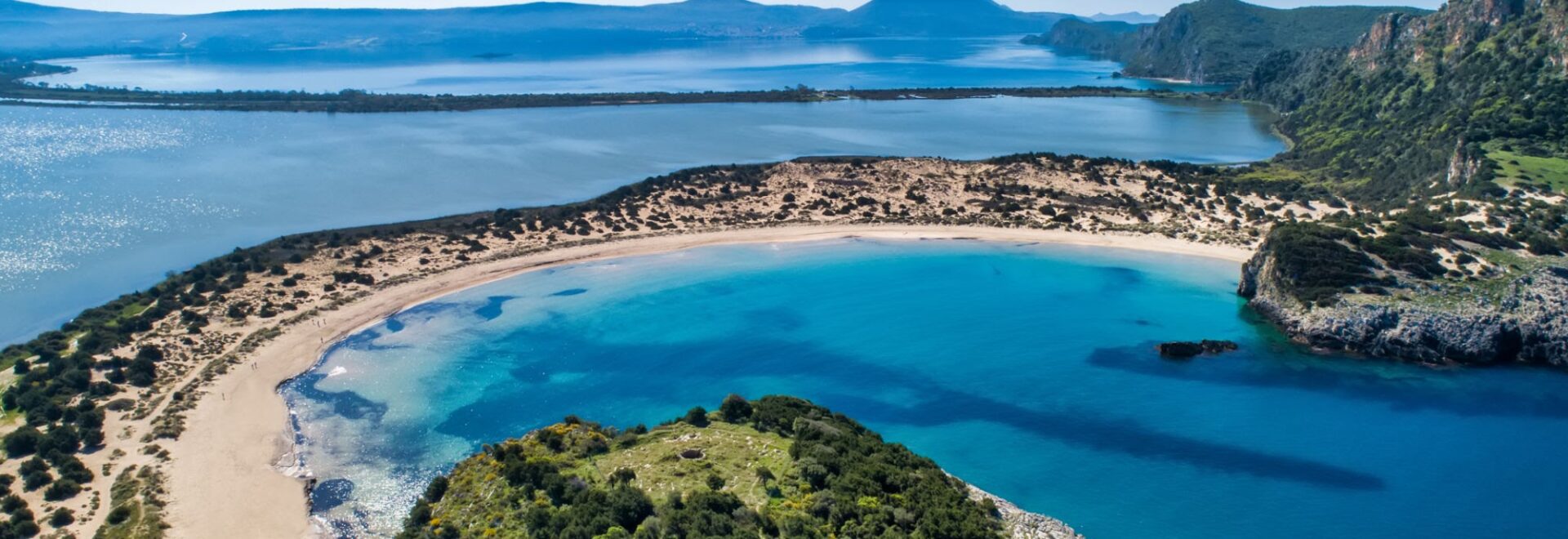

Voidokilia Beach is a protected, omega-shaped bay on the western coast of Messinia, in the southwestern Peloponnese, near the village of Petrochori and just north of Gialova. It’s free to visit, reached by a short walk from a parking area at the end of a dirt road, and about an hour’s drive from Kalamata Airport. There are no facilities on the sand, so you bring what you need for the day.
I’ll say it plainly: Voidokilia is the beach that other Greek beaches get compared to. That near-perfect horseshoe of pale sand wrapped around calm, shallow, turquoise water has no equal on the mainland — and because it’s a protected nature reserve with no development, it looks today much as it always has. It recently drew a fresh wave of visitors after appearing as a filming location in The Odyssey, but it was a bucket-list beach long before Nolan’s cameras arrived. Here’s everything you need to plan a good day there.
Where is Voidokilia Beach?
Voidokilia sits on the western coast of Messinia, on the far side of Navarino Bay from the town of Pylos, next to the village of Petrochori and the Gialova Lagoon. The name means “ox belly” in Greek—voidi (ox) and koilia (belly)—after the rounded curve of the bay, and it’s occasionally written “Voidokoilia” in English.
The beach is one edge of a genuinely special stretch of landscape. Behind it lies the Gialova Lagoon, one of the more important wetlands in Europe and a well-known birdwatching site. Above it rise the slopes that hold Nestor’s Cave and the ruined fortress of Palaiokastro (Old Navarino). It’s this combination—a wild, undeveloped bay backed by dunes; a protected lagoon; and clifftop ruins—that gives Voidokilia its character and is the reason it’s a Natura 2000 protected site rather than an organized resort beach.
How do you get to Voidokilia Beach?
Most people drive. Voidokilia is roughly 55 km (about an hour) from Kalamata Airport, 15 km (about 25 minutes) from Pylos, and around 9 km (15 minutes) from Gialova. From Athens it’s about 280 km, or three to three and a half hours by car. Treat these as approximate—the exact time depends on your starting point and the season.
| From | Approx. distance | Approx. drive time |
|---|---|---|
| Kalamata Airport (KLX) | 55 km | 1 hr |
| Pylos | 15 km | 25 min |
| Gialova | 9 km | 15 min |
| Athens (city / airport) | 280 km | 3 hr – 3 hr 30 min |
The usual route is to head to Petrochori and follow the local signs toward Voidokilia; the paved road then gives way to a flat dirt track running past the Gialova Lagoon to the parking area.
Public transport is limited. KTEL buses can get you as far as Pylos or, with connections, Petrochori, but nothing runs to the beach itself—so you’d still need a taxi or a walk for the final stretch. If you’re flying into Kalamata and don’t want to drive, a private transfer from Kalamata can take you to Pylos or Petrochori; because the beach is remote and facility-free, it’s worth arranging your return in advance rather than hoping to find a ride afterwards. Coming from the capital, a private transfer from Athens covers the door-to-door journey if you’d rather not drive.

Where do you park at Voidokilia Beach?
Parking is free, but it’s informal. Because the area is a protected reserve, there’s no paved car park — you park in the open area where the dirt road ends, and from there it’s about a five-minute walk through the dunes to the sand. There’s no entrance fee and no ticket; Voidokilia is a natural reserve that’s free to visit.
A practical warning worth taking seriously: the final approach is a sandy dirt road, and low-clearance cars can get stuck near the dunes. If you’re in a small economy car, drive slowly, and if in doubt, park earlier along the Gialova Lagoon side and walk the last stretch rather than risk the softest sand. In July and August, the spaces near the beach fill up, so arriving early pays off twice: easier parking and a quieter beach.
When is the best time to visit Voidokilia Beach?
The most comfortable months are May, June, September, and early October: warm enough to swim, with far more room than midsummer. July and August are the busiest, especially between roughly 11:00 and 18:00, when the parking and the sand are at their fullest.
If you’re visiting in peak summer, the simple fix is timing your day around the crowds: come before about 9:30 in the morning or in the late afternoon. You’ll find parking, space on the sand, softer light for photos, and—if you stay into the evening—one of the better sunsets in the Peloponnese. Two things to expect whatever the month: the water can feel cooler than it looks, and mosquitoes can appear around dusk near the lagoon.

What should you bring to Voidokilia?
Voidokilia has no sunbeds, no umbrellas, no beach bar, no canteen, and no lifeguards—that’s the trade-off for its untouched setting. Plan for a facilities-free day:
- Water and snacks — there’s nowhere to buy anything on the beach.
- Shade — bring your umbrella; there’s no natural shade on the sand.
- Sun protection and a hat—the bay faces the open sky with no cover.
- Sturdy shoes — useful if you plan to hike up to Nestor’s Cave.
- Insect repellent is handy near the lagoon around dusk.
The nearest tavernas are in Petrochori, a couple of kilometers away, or in Gialova, about five kilometers off. As a protected site, the rule of thumb is simple: take everything back out with you, and keep off the dunes, which are part of the reserve.
Is Voidokilia particularly suitable for swimming and families?
Yes, it’s one of the calmer, safer swimming beaches in the region. The bay’s enclosed, horseshoe shape and gently sloping, shallow entry make it well suited to families with young children and to less-confident swimmers, and the water is exceptionally clear. On windier days you’ll notice more movement toward the middle and right of the bay, so the left and far edges tend to stay calmest.
Because there are no lifeguards, keep the usual care with children and don’t rely on any facilities being nearby. Many visitors walk around to the far right of the bay for a quieter spot—with the bonus that it puts you close to the foot of the path up to Nestor’s Cave.
Can you hike to Nestor’s Cave above the beach?
Yes. A signed footpath climbs the headland from the northern end of Voidokilia to Nestor’s Cave and the ruins of Palaiokastro above—a short but steep, unshaded walk of roughly 15 to 20 minutes, rewarded with wide views back over the omega-shaped bay. In mythology, the cave is linked to Nestor and Hermes, and it recently featured as the Cyclops’ lair in The Odyssey.
It’s a natural, unstaffed site, so treat it with care: stay on the marked path, wear proper shoes rather than beach sandals, and keep back from the cliff edges. Even if you only climb as far as the cave mouth, the viewpoint alone is worth the effort. If the film brought you here, our guide to The Odyssey filming locations in Greece maps out the other nearby sites—Methoni Castle, Pylos, and Almyrolakka Beach.
What else is nearby?
Voidokilia works best as part of a day around the Navarino coast. Pylos, 25 minutes away, is a pretty harbor town with tavernas and a castle overlooking the bay. Gialova and its lagoon are excellent for a slower morning and some birdwatching. Methoni Castle, a Venetian sea fortress about 30 minutes south, is one of the most striking monuments in Messinia. And the Palace of Nestor, the best-preserved Mycenaean palace in Greece, sits a short drive inland near Chora. With a car or a booked driver for the day, you can comfortably link two or three of these around a morning swim at Voidokilia.
Frequently asked questions
How do you get to Voidokilia Beach? 
Voidokilia is easiest to reach by car. It’s about 55 km (roughly an hour) from Kalamata Airport, 15 km (25 minutes) from Pylos, and 9 km (15 minutes) from Gialova. You drive toward the village of Petrochori and follow local signs; the paved road turns into a dirt track leading to a parking area, from where it’s a short walk to the sand. Public transport is limited — buses reach Pylos or Petrochori at best, and none go to the beach — so if you’re not driving, a taxi or a private transfer for the final stretch is the practical option.
Is there parking at Voidokilia Beach, and is it free?
Yes, parking is free, but it’s informal rather than a paved car park. You park in the open area where the dirt road ends, then walk about five minutes through the dunes to the beach. There’s no entrance fee and no ticket — Voidokilia is a protected natural reserve that’s free to visit. The one thing to watch is the sandy final approach: low-clearance cars can get stuck near the dunes, so drive slowly, and in peak summer arrive early because the nearest spaces fill up quickly.
What is the best time to visit Voidokilia Beach?
May, June, September and early October are the most comfortable months, with warm water and fewer people than midsummer. July and August are the busiest, especially between about 11:00 and 18:00. If you visit in peak season, come before roughly 9:30 in the morning or in the late afternoon — you’ll find parking, more room on the sand, and better light, and if you stay on you’ll catch a memorable sunset. Whatever the month, expect the water to feel cooler than it looks and some mosquitoes near the lagoon around dusk.
Are there any facilities at Voidokilia Beach?
No. Voidokilia has no sunbeds, umbrellas, beach bar, canteen or lifeguards — the lack of development is exactly what makes it feel wild and unspoiled. You’ll need to bring your own water, food, shade and a beach mat, along with sun protection and, near the lagoon at dusk, insect repellent. The nearest tavernas are in Petrochori, a couple of kilometres away, or Gialova, about five kilometres off. Because it’s a protected Natura 2000 site, take everything back out with you and keep off the dunes.
Is Voidokilia Beach safe for swimming and children?
Yes, it’s one of the calmer swimming beaches in the area. The enclosed, horseshoe shape and shallow, gently sloping entry make it well suited to families and less-confident swimmers, and the water is very clear. There are no lifeguards, so supervise children as you normally would. On windy days there’s more movement toward the middle and right of the bay, while the far edges stay calmer — which is also where you’ll be closest to the path up to Nestor’s Cave.
Why is Voidokilia Beach famous?
Voidokilia is known for its near-perfect omega (Ω) shape—a natural horseshoe of pale sand enclosing shallow, turquoise water—and regularly features on lists of Europe’s most beautiful beaches. It’s also part of a protected landscape that includes the Gialova Lagoon wetland and the clifftop ruins of Palaiokastro, with Nestor’s Cave on the slopes above. More recently, it drew international attention as a filming location in Christopher Nolan’s The Odyssey, where the bay and the cave above it appear on screen. It has been linked to Homer’s world since antiquity.