The Devil Wears Prada 2 hits theaters May 1, 2026. If the first film was about how the fashion industry works, the sequel needs a city where fashion isn’t an industry at all—Devil Wears Prada 2 hits theaters May 1, 2026. The full original cast is back (Meryl Streep, Anne Hathaway, Emily Blunt, and Stanley Tucci), and this time, part of the story moves to Milan. The production filmed there in October 2025, with Streep and Tucci spotted at the Dolce & Gabbana Milan Fashion Week show in late September. None of the above is a coincidence.
This guide is your complete fashion travel guide to Milan: where to go, what to see, how to move through the city like someone who belongs there, and how to arrive without the kind of chaos that ruins the first impression.
Why Milan is the fashion capital (and what that actually means for travelers)
Every major city has a claim on fashion. Paris has a history of haute couture. New York has the industry infrastructure. London has the subculture energy. Milan has all of it quietly built into the architecture, the food culture, and the way someone dresses to pick up a coffee at 8am on a Thursday.
The Milanese don’t dress up for occasions. They dress as a baseline. Style here isn’t a performance; it’s the operating system. Walking through the Quadrilatero della Moda on a random Tuesday and watching people move through their day is a more educational fashion experience than most museum exhibitions.
For fashion-conscious travelers, the experience changes how they plan their trips. You’re not visiting a fashion city. You enter a fashion world that runs continuously, with or without you, and your job is to plug into it correctly for however long you’re there. This guide is how you do that.

The Milan fashion district: Quadrilatero della Moda
Every fashion trip to Milan starts here. The Quadrilatero della Moda (the Golden Rectangle formed by Via Montenapoleone, Via della Spiga, Via Sant’Andrea, and Via Manzoni) is the geographic center of Italian fashion and one of the most concentrated luxury corridors in the world.
The standard advice is to shop here. Better advice: walk the route first without a shopping agenda.
The Quadrilatero della Moda is best understood as a world with its population and its own rules. The people moving through it on any given morning are buyers between appointments, editors on their way somewhere, and PRs operating with a sense of urgency they never fully explain. The window displays are designed by the same people who design the collections. The shopfronts are architecturally significant in ways most visitors don’t stop to notice.
The Prada flagship on Via Montenapoleone is worth entering for the interior architecture alone. So is Valentino. So is Bottega Veneta. These aren’t stores in the conventional retail sense, but brand philosophies expressed in three dimensions.
Via Montenapoleone is the spine of the district and the most famous address in Italian fashion. It’s also where you’ll find Antonia, one of the best concept stores in Milan, with genuinely editorial curation that reads more like a magazine than a shop floor. The edit is sharp, changes regularly, and stocks names you know alongside names you probably should.
10 Corso Como, slightly north of the Rectangle on Corso Como, is the original concept store for Milan fashion, opened by former fashion editor Carla Sozzani in 1990 and still the benchmark for how fashion, art, design, and hospitality can share the same space without any of them losing integrity. There’s a gallery, a bookshop, a garden restaurant, and a small hotel. Budget a 90-minute minimum and go without a fixed agenda.

Where to shop in Milan: Beyond the obvious
The Quadrilatero is the obvious answer. These are the better ones.
- Spazio Rossana Orlandi in the Magenta neighborhood is hidden in a former tie factory and sits at the intersection of fashion, design, furniture, and objects that don’t fit clean categories. The space itself is a curatorial statement. Things here are chosen because they have something to say. Budget an hour and leave with something you didn’t know you needed.
- Banner on Via Sant’Andrea stocks the international avant-garde fashion that Milan doesn’t always celebrate loudly—Comme des Garçons, Dries van Noten, and Marni—with the kind of editorial sensibility that rewards actually browsing rather than searching for something specific.
- Wait and See in Brera is the independent boutique that Milanese women in their 30s and 40s shop at when they want something that isn’t available everywhere. Small, personal, and consistently intriguing in a way that chain retail never is.
- Biffi on Corso Genova has been dressing Milan since 1967. It carries the multi-brand authority of a store that was curating before curation became a word the industry used.
Milan’s fashion museums: Where style becomes history
No fashion trip to Milan is complete without at least one full day given to the museums. Milan has the strongest fashion museum ecosystem of any city in the world, and the two non-negotiable stops are genuinely unlike anything else on the map.
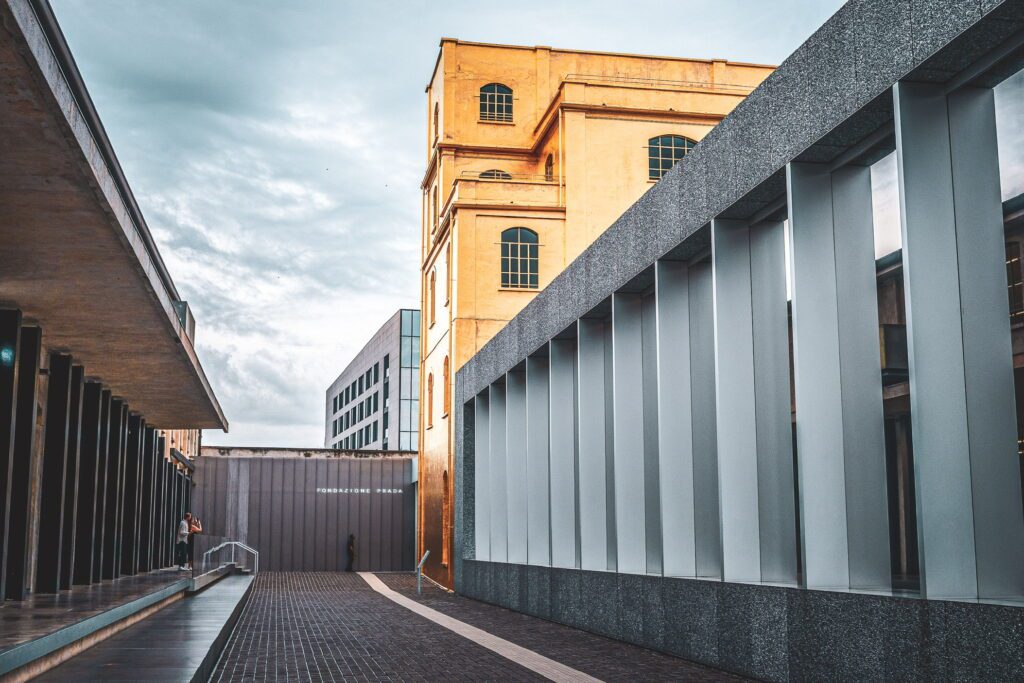
Fondazione Prada
The most important fashion destination in Milan is not a store.
Miuccia Prada converted a 1910 distillery in the Largo Isarco area into a contemporary art and culture campus. The campus features multiple pavilions, a cinema, a bar designed by Wes Anderson called Bar Luce, and the Haunted House, which is a building covered in 24-karat gold leaf that you can photograph from every angle yet still not fully capture.
The Fondazione is where fashion travel stops being about consumption and starts being about ideas. The exhibitions rotate but consistently treat fashion as an intellectual and cultural force rather than a commercial one, which is Miuccia Prada’s central argument as a designer, a collector, and a cultural figure.
Plan two to three hours. Go without a fixed agenda. This is the version of Milan that the Devil Wears Prada universe gestures at: fashion not as vanity but as a serious way of looking at the world.
Armani/Silos
Giorgio Armani opened his personal fashion museum in 2015 in a former Nestlé factory near the Navigli. Four floors of archival looks spanning fifty years of one of the most consistent design visions in fashion history.
The experience is fundamentally about restraint: what you can strip away and still say everything you need to say. Walking through the archive is a lesson in what it means to build a fashion identity across decades rather than seasons. It’s also the necessary counterpoint to the Fondazione: where Prada’s project is expansive and intellectually restless, Armani’s is focused to the point of meditation.
If you can only do one fashion museum in Milan, go to the Fondazione. If you can do two, Armani/Silos is the second, even though it’s not a distant second.
Milan Fashion Week: What to know as a traveler
Milan Fashion Week runs in September for the Spring/Summer collections and in February for Fall/Winter. And if your trip overlaps with either, the city transforms in ways worth experiencing even without industry access.
The street style around the Fondazione Prada and outside the major show venues during Fashion Week is worth the trip on its own. Position yourself on Via Savona or near the Armani Teatro during show days and watch the industry move.
Photographers with long lenses, editors in outfits that cost more than most people’s monthly rent, PRs moving at speeds that suggest the building is on fire.
Outside of Fashion Week, the fashion calendar still structures the city. New collections drop on a rhythm that the boutiques follow closely, and the Quadrilatero della Moda shifts its window displays and in-store edits regularly enough that two visits to Milan a year will show you a meaningfully different city each time.
The best months for a fashion trip to Milan if you’re not timed to Fashion Week are April through June and September through October. The weather supports the walking that fashion Milan requires, and the city is operating at full tempo.
Where to eat and drink like the fashion crowd
The aperitivo is not optional. In Milan, it’s a social institution and, between 6:30 and 9pm, something of a fashion event in its own right. The bars around Brera and the Navigli fill with people who are dressed for the occasion. Showing up in athleisure is technically possible and socially noted.
Bar Basso on Viale Plinio invented the Negroni Sbagliato and remains a popular meeting spot during fashion week all year. Arrive at seven. Order what it’s famous for. Stay longer than you planned.
For dinner, Langosteria Bistrot on Via Savona is the more accessible sibling of the flagship Langosteria, with the same seafood-forward elegance but slightly shorter lead time on reservations. The crudi are exceptional. Book in advance regardless of how far out you are.
Ratanà near Porta Nuova is a Milanese institution: classic regional cooking, a beautiful interior, and a clientele that looks like it has somewhere to be in the afternoon. Order the risotto. This is not a suggestion.
Breakfast: Pasticceria Marchesi on Via Monte Napoleone, now Prada-owned, is where you do it properly. A deep green interior, impeccable cornetti, and a cappuccino that arrives exactly right. The Prada owner tells you something about how Milan integrates fashion into daily rituals without making a production of it.
Spend at least one evening in Navigli, the canal neighborhood in the southwest that feels like Milan is exhaling. A glass of natural wine, outside seating, and the city at rest. The fashion industry doesn’t show up here the way it shows up in the Quadrilatero, which is precisely why it belongs in this itinerary. Milan style at rest looks different from Milan style on display, and both are worth seeing.

Getting to Milan: Arrive like you mean it
Milan has two major airports for international travel. Malpensa (MXP) is the primary international hub, about 50 kilometers northwest of the city center and roughly 45 to 60 minutes by road, depending on traffic. Linate (LIN) is closer—about 7 kilometers east of the center—and handles mostly European and domestic routes.
Here’s where most fashion trips to Milan go wrong before they’ve even started: the airport transfer.
Malpensa in particular has a reputation for chaos at arrival with long taxi queues, unlicensed drivers, and the general friction of a major international hub that handles significant volume. The last thing you want after a flight is to stand in a queue, negotiate with a driver whose meter is a suggestion, or figure out train connections with a suitcase. The first impression of a city matters, and Milan’s fashion energy does not begin at the taxi rank.
Welcome Pickups is the straightforward solution. Pre-book your transfer before you land, and a vetted, English-speaking driver will be waiting for you at arrivals, with no queue, no negotiation, and a fixed price. For a city where how you arrive is part of the experience, it’s the only approach that makes sense. Welcome Pickups operates across 360+ destinations worldwide, which means the same logic applies on the way out: your return transfer is handled, trackable, and not something you’re thinking about during your last aperitivo at Bar Basso.
Book a Milan airport transfer before you travel. Arriving stressed is not the energy Milan requires of you.
Milan style: The unwritten rules
A few things about Milan fashion that no guidebook spells out clearly enough:
- Wear something intentional. Not expensive; intentional. The city has an ambient dress code, and it notices what you’re wearing in the way a fashion capital does: with genuine attention. Leave the athleisure at the hotel.
- Walk slowly. The Milanese move with purpose but not with rushing. Speed is for people who haven’t figured out where they’re going. Walking the Quadrilatero like you have somewhere better to be is the fastest way to mark yourself as a tourist.
- Look up. Milan’s fashion geography is also an architectural story, and most visitors miss it entirely by keeping their eyes at street level. The buildings on Via Montenapoleone, the dome of the Galleria Vittorio Emanuele II, and the Fondazione Prada campus: these are places that reward the kind of attention you bring to a well-made garment.
- Go back. The best fashion trip to Milan is the second one. The first visit is orientation. The second is when you actually understand what you’re looking at.
Milan fashion travel doesn’t involve accessing a closed world. The Quadrilatero della Moda is a public street. The Fondazione Prada has a ticket desk. The aperitivo bars are open to anyone. Milan wants you to pay attention to the clothes, spaces, people, and details and treat them as seriously as it does.
Devil Wears Prada 2 chose Milan because that’s where the argument about fashion gets serious. Come ready to participate.
Frequently asked questions
Is Milan worth visiting for fashion lovers? 
Yes, unconditionally. Milan is the city where fashion is most fully integrated into daily life, not as an industry you visit but as an ambient cultural condition. The Quadrilatero della Moda, Fondazione Prada, and Armani/Silos alone justify the trip, and the surrounding restaurant and aperitivo culture is the best context in which to understand what Italian style actually means.
What is the Milan fashion district called?
The main fashion district in Milan is the Quadrilatero della Moda (also called the Golden Rectangle) formed by Via Montenapoleone, Via della Spiga, Via Sant’Andrea, and Via Manzoni. The major luxury flagships and some of the city’s best concept stores concentrate here.
When is Milan Fashion Week?
Milan Fashion Week runs twice a year: February/March for Fall/Winter collections and September for Spring/Summer. Both editions transform the city and are worth timing your trip around even without show access, purely for the street style and the energy of the city during those days.
Did Devil Wears Prada 2 film in Milan?
Yes. Production filmed in Milan, Italy, from October 6 to 18, 2025, with Meryl Streep and Stanley Tucci also filming at the Dolce & Gabbana Milan Fashion Week show on September 27. The film is scheduled to release on May 1, 2026.
What are the best fashion museums in Milan?
The two essential fashion museums in Milan are Fondazione Prada (a contemporary art and culture campus created by Miuccia Prada in a converted 1910 distillery) and Armani/Silos, Giorgio Armani’s personal fashion archive spanning five decades, housed in a former factory near the Navigli. Both require at least two to three hours, and they reward going without a fixed agenda.
How do I get from Malpensa airport to Milan city center?
The best options are a pre-booked private transfer (recommended for fashion travellers who want a fixed price and no airport friction), the Malpensa Express train to Cadorna or Centrale station, or a licensed taxi from the official taxi rank. Pre-booked transfers through services like Welcome Pickups are the most seamless option, with your driver waiting at arrivals, the price set in advance, and you being in the city in under an hour.
What should I wear in Milan?
“Intentional” is the word. Milan’s ambient dress code rewards effort and notices the lack of it. You don’t need to dress expensively; you need to look like you made a decision. Smart casual at minimum, with appropriate shoes that can handle cobblestones. Leave the athleisure at the hotel.
How many days do I need for a fashion trip to Milan?
Three days is the workable minimum for doing the city justice. That’s enough time for the Quadrilatero, both fashion museums, the Navigli, and a few concept stores. Five days gives you room to slow down and actually absorb it. If you’re timing a visit around Fashion Week, build in at least one extra day for the general energy of the city during that period.